What Is Plant Tissue Culture?
Plant tissue culture is a method of propagating plants by growing small pieces of plant tissue in a sterile, controlled environment. Under the right conditions, these tiny pieces — called explants — can regenerate into complete, healthy plants that are genetically identical to the original.
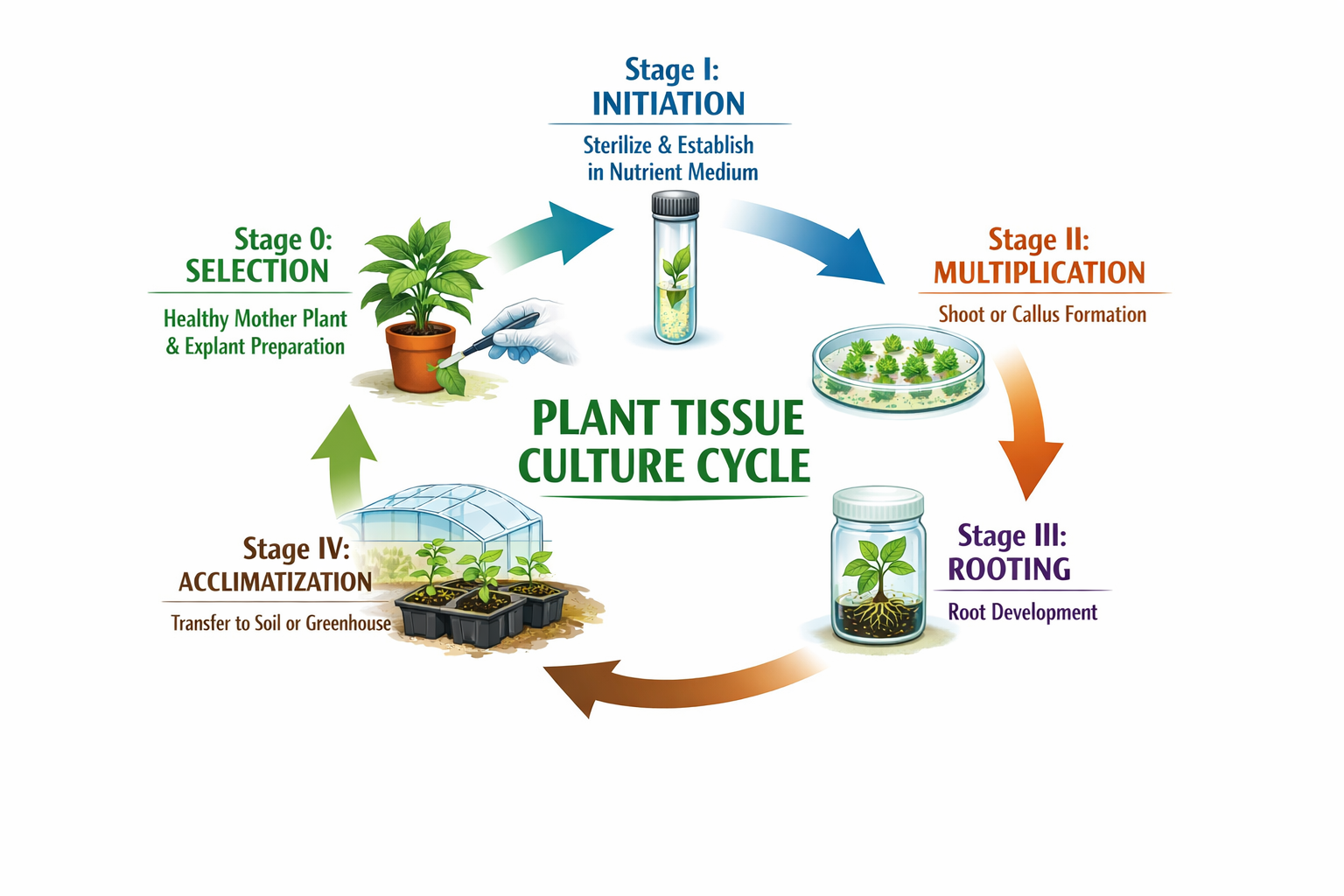
How Plant Tissue Culture Works
Plant tissue culture takes advantage of an amazing natural ability found in plants called totipotency — the ability of a single cell to regenerate into an entire plant. The process typically follows a few key steps:
Stage 0 — Selection & Explant Preparation
The process begins with choosing a healthy mother plant with desirable traits — flavor, fragrance, growth habit, disease resistance, or simply botanical interest. A small piece of tissue is taken from this plant: a shoot tip, axillary bud, stem segment, leaf, or meristem. This piece is called an explant. The mother plant is sometimes pretreated to reduce microbial load before tissue is harvested.
Stage I — Initiation
The explant is surface-sterilized to eliminate bacteria and fungi, then placed into a sealed vessel containing a nutrient medium — a precise blend of water, mineral salts, vitamins, sugars, plant growth regulators, and a gelling agent. This is done under aseptic conditions in a laminar flow hood. The goal of Stage I is to establish a clean, viable culture that responds to the growth environment. Not every explant survives this step — contamination and tissue browning are common challenges.
Stage II — Multiplication
Once established, the culture enters the multiplication phase. Under controlled light and temperature, the tissue produces multiple shoots — sometimes through axillary branching, sometimes through adventitious shoot formation or callus-mediated organogenesis. These shoots can be divided and subcultured onto fresh media, allowing one original explant to become many identical plants over successive transfer cycles. Media formulations and hormone ratios are often adjusted during this stage to optimize multiplication rates while maintaining genetic stability.
Stage III — Rooting
When shoots are large and vigorous enough, they are transferred to a rooting medium — typically with reduced or different plant growth regulators that encourage root development rather than shoot proliferation. Some species root easily in culture; others require specific auxin treatments, darkness, or ex vitro rooting techniques. The goal is a complete plantlet with functional roots, ready for life outside the vessel.
Stage IV — Acclimatization
The most delicate transition. Plantlets grown in vitro have underdeveloped cuticles and stomata that don't yet regulate water loss effectively. They must be carefully removed from their sterile vessels, rinsed of residual media, and planted into a sterile substrate under high humidity. Over several weeks, humidity is gradually reduced and light intensity increased, training the plant to survive in ambient conditions. This hardening-off process is critical — rushing it is the most common cause of loss at this stage.
Why Use Plant Tissue Culture?
Disease-Free Plants
Cultures are grown free of fungal and bacterial contamination. Through meristem culture, even viruses and viroids can be eliminated from plant tissue.
True-to-Type Clones
Plants retain the exact characteristics of the parent plant — important for flavor, fragrance, or unique traits.
Preservation of Rare or Valuable Plants
Tissue culture allows plants to be maintained and multiplied without repeated harvesting from mature specimens. Tissue samples can be stored for long periods of time until needed.
Efficient Use of Space
Large numbers of plants can be grown in a relatively small area.
Crop Improvement & Breeding Support
Techniques such as embryo rescue can aid in the success of wide hybrids.
Why Buy Plants In Vitro?
Not every tissue-cultured plant goes through acclimatization before it reaches the buyer. Many growers prefer to purchase plants still in culture — sealed in their sterile vessels — and handle the deflasking and hardening process themselves. There are good reasons for this:
Sterile & Protected
In vitro plants are grown in sealed, sterile environments — significantly reducing the risk of fungal and bacterial contamination, pests, and soil-borne diseases that can affect conventionally grown plants.
Safe to Ship
Sealed culture vessels protect plants during transit, greatly reducing the risk of wilting, drying out, or root disturbance — making in vitro plants well-suited for shipping year-round.
Longer Shelf Life
Plants can remain viable in their culture vessels for weeks or even months, giving the buyer flexibility on when to begin the acclimation process.
Rewarding for Growers
For hands-on growers, deflasking and acclimating tissue-cultured plants is a deeply satisfying process — and a great way to develop skills in plant care and propagation.
Plantaera's Approach
At Plantaera Biotech, plant tissue culture is practiced intentionally on a small scale. Rather than industrial production, the focus is on careful handling, close observation, and time spent with each culture.
This approach allows for better quality control and ensures that plants are propagated with attention and respect for the living material. The goal is not speed or volume, but healthy, well-grown plants.
Plant tissue culture is a powerful tool for the future of horticulture, conservation, and agriculture. When practiced thoughtfully, it allows us to preserve plant genetics, share exceptional plants responsibly, and deepen our understanding of how plants grow and regenerate. At its best, tissue culture is science in service of plants — a way to work with plants, not against them.
Ready to see what's available?
Browse our current inventory of tissue-cultured plants.